
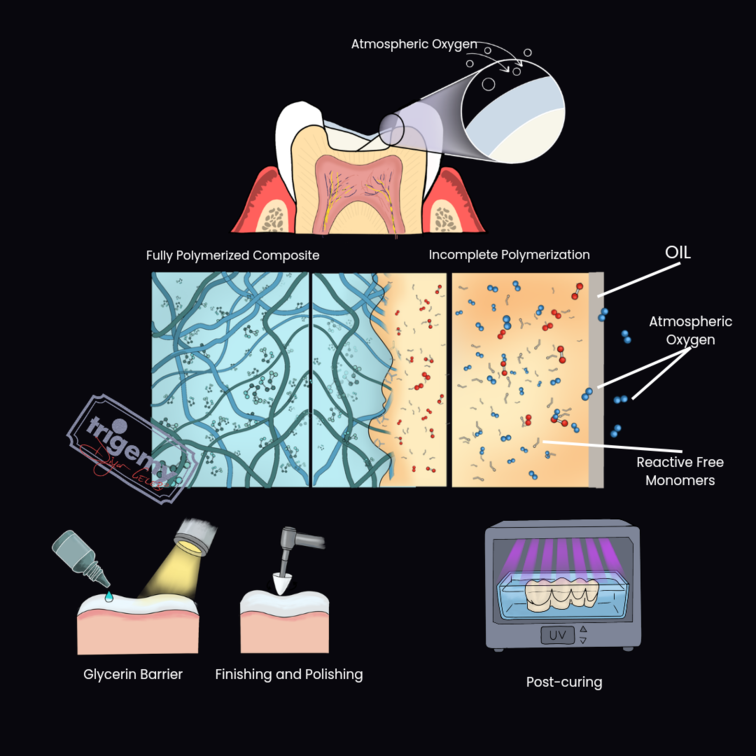
When composite materials are polymerized, complete polymerization does not occur in the superficial layer. The primary reason for this is that oxygen present in the environment reacts with free radicals during polymerization, interrupting the chain reaction at the surface. As a result, a thin, unpolymerized, sticky layer rich in residual monomers forms on the surface. This structure is referred to as the oxygen inhibition layer. The presence of this layer can be both advantageous and disadvantageous.
Advantages
In layered composite restorations, this layer plays an important role. The reactive monomers present on the surface enable chemical bonding with subsequently applied composite layers. Therefore, the oxygen inhibition layer provides a significant advantage for the success of incremental layering techniques.
Disadvantages
However, when this layer remains on the outermost surface of the restoration, it can lead to several problems. Due to the lower degree of polymerization, surface hardness decreases, susceptibility to discoloration increases, and long-term issues such as wear and biofilm accumulation may occur. These effects can result in clinical failure, particularly in esthetic regions.
Solutions
Before final polymerization, the application of glycerin to the outer surface of the composite creates a barrier that prevents contact between oxygen and the composite surface. This allows free radicals to continue the polymerization process without being inhibited by oxygen, resulting in a higher degree of conversion at the surface.
Even if glycerin is not used, polishing procedures can effectively remove this superficial layer and surface irregularities, thereby improving color stability and enhancing the long-term performance of the restoration.
Relevance in Digital Dentistry
Today, 3D printing resins and polymerization processes widely used in digital dentistry are similarly exposed to oxygen at their external surfaces. Therefore, understanding oxygen inhibition is critical for optimizing both conventional and digital restorative workflows.
We use cookies to ensure the best experience on our website. By continuing to browse this site, you agree to our use of cookies. Learn more in our User Agreement, Privacy Policy, and GDPR Notice.